
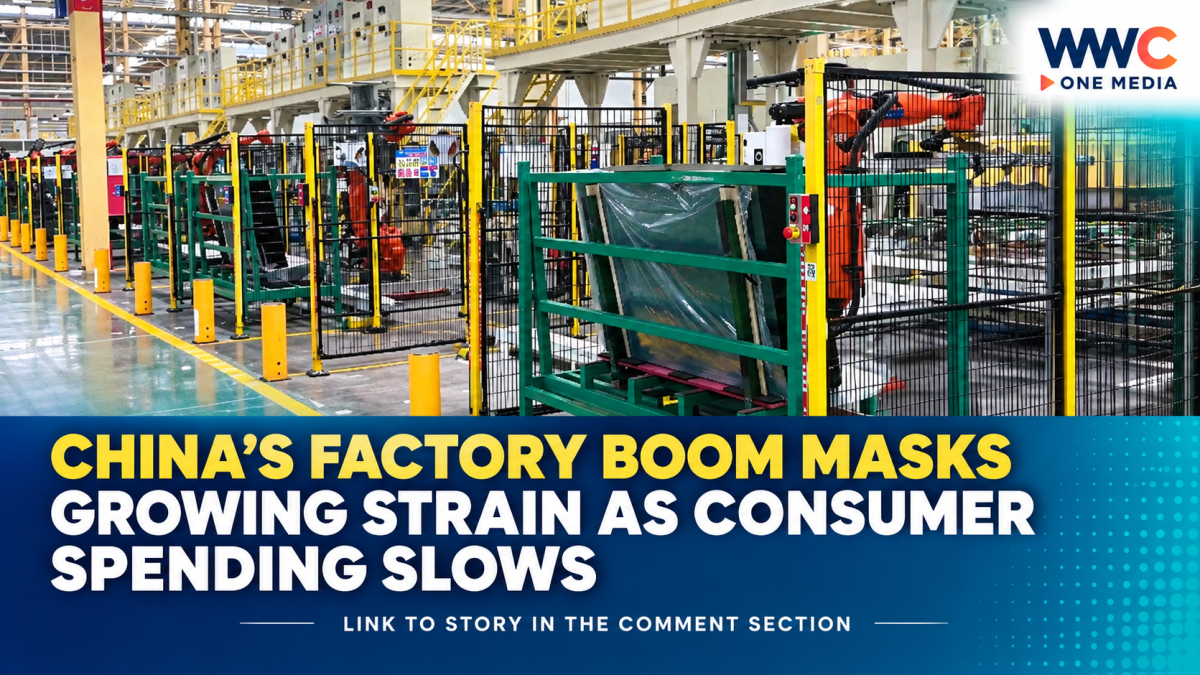
China’s manufacturing sector continues to expand at a rapid pace, driven by booming demand for electric vehicles, batteries, solar panels and other high-tech products. But the surge in industrial output is exposing a growing imbalance in the world’s second-largest economy as domestic consumption struggles to keep pace.
Factories across China have poured investment into advanced industries, helping the country strengthen its position in global supply chains and become a major exporter of technology-intensive goods.
The expansion has been particularly visible in electric vehicles, renewable-energy equipment and batteries, sectors that Beijing has identified as key drivers of future economic growth.
Yet the strength of manufacturing contrasts sharply with weaker household demand.
Retail sales have grown more slowly, while the prolonged property downturn has continued to weigh on consumer confidence and household wealth. Many Chinese consumers remain cautious about spending, with uncertainty over jobs and income encouraging households to save rather than make large purchases.
The result is an economy producing more goods than its domestic market can readily absorb.
Companies have responded by competing aggressively on price and looking overseas for customers. That has helped Chinese exports remain resilient, but has also intensified trade tensions with the United States, Europe and other markets concerned about excess industrial capacity and the impact of heavily subsidised Chinese products.
Economists have warned that relying too heavily on manufacturing and exports could make it harder for China to achieve more balanced, consumption-driven growth.
The government has introduced measures aimed at encouraging household spending, including consumer subsidies and trade-in programmes for cars and household appliances. However, analysts say stronger social safety nets, higher household incomes and a more sustained recovery in the property sector may be needed to convince consumers to spend more confidently.
At the same time, China’s push into high-tech manufacturing is creating new opportunities in industries such as artificial intelligence, robotics, clean energy and advanced electronics.
The challenge for policymakers is to ensure that the benefits of that industrial expansion translate into stronger household demand rather than widening the gap between production and consumption.
With global demand becoming increasingly uncertain and trade barriers rising in several major markets, China’s ability to shift from an investment- and export-heavy model towards one driven more by consumers remains a central issue for its economic outlook.




Leave a Reply