
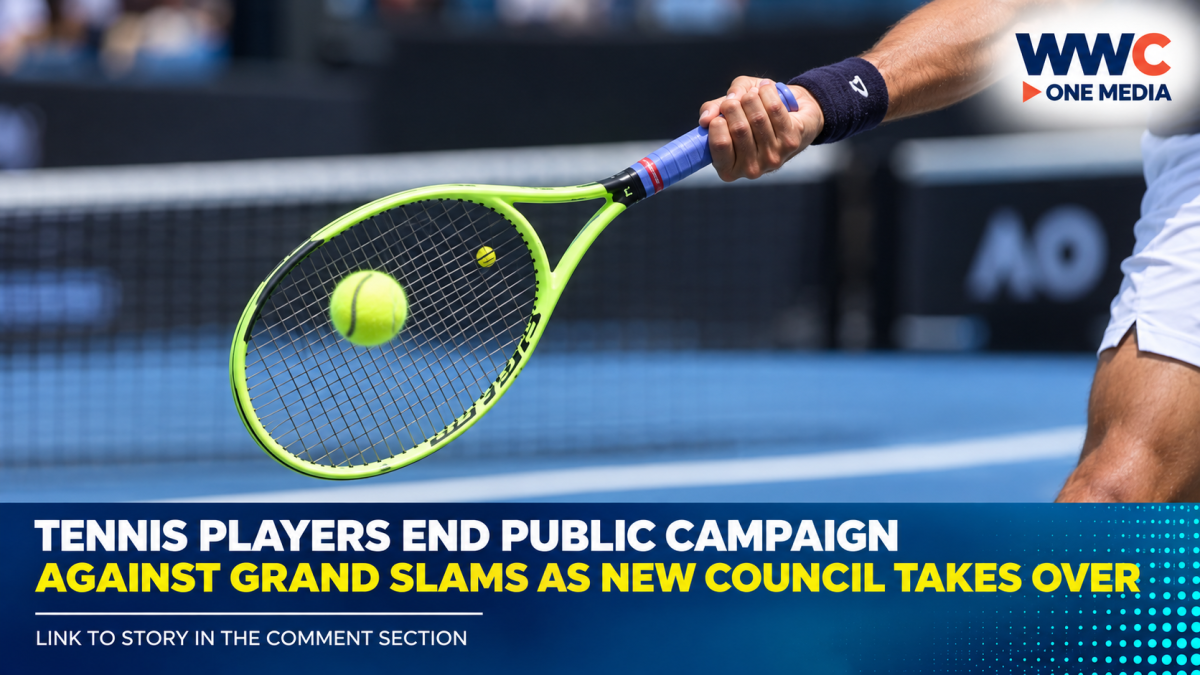
NEW YORK — The high-profile battle between tennis players and the four Grand Slam tournaments is entering a new phase.
Top players have ended the public campaign they launched to demand a larger share of Grand Slam revenues, stronger player welfare programs and a greater voice in tournament decision-making. Instead of further public protests, the players will now pursue those goals through a newly established Grand Slam Player Advisory Council.
The decision marks a significant shift after roughly 18 months of increasingly tense negotiations between leading players and the Australian Open, Roland-Garros, Wimbledon and US Open.
But it is not the end of the fight.
The players have made clear that they can restart the campaign if the new council fails to produce meaningful progress.
From public protests to a seat at the table
The campaign began in March 2025, with players pushing for greater influence over Grand Slam decisions, improved welfare support and a bigger portion of tournament revenues.
One of the central demands has been a goal of 22% of Grand Slam tournament revenue going toward prize money by 2030.
The campaign became increasingly visible in 2026. Players reduced or skipped certain media obligations at Roland-Garros and prepared further action around Wimbledon, putting additional pressure on tournament organizers.
Now, the players say the creation of a formal council provides a more direct mechanism for negotiations.
Rather than relying on public pressure, representatives will have an established forum through which they can raise issues directly with Grand Slam organizers.
Grand Slam prize money has surged
The campaign has already coincided with substantial increases in prize money at all four majors.
For 2026, reported prize pools reached approximately:
- Australian Open: $79.92 million
- French Open: $71.56 million
- Wimbledon: $86.79 million
- US Open: $108 million
Together, the increases represent more than $30 million above historical growth trends, according to the players’ group.
The US Open’s $108 million total compensation package also represented a record for the tournament.
Players have therefore argued that their coordinated campaign produced tangible financial gains, even though their broader revenue-sharing target has not yet been achieved.
A new council changes the power dynamic
The Grand Slam Player Advisory Council was formally announced in August by the four major tournaments.
Its purpose is to create a direct channel between players and Grand Slam organizers on sporting issues, player welfare and compensation, including prize money.
The council is expected to launch following the 2026 US Open.
The four Grand Slams are working with players to establish its initial composition, operating framework and structure. Players will be invited to apply for positions on the council.
That represents a major change from the previous system, where players often had to communicate their concerns through separate tours, player councils or individual negotiations.
Jessica Pegula and Ben Shelton have both welcomed the opportunity for players to have a more formal voice in shaping the sport’s biggest tournaments.
The money fight is far from over
Despite the truce, the central financial dispute remains unresolved.
Players still want a more transparent and substantial connection between Grand Slam revenues and player compensation, with the 22% revenue-share target remaining an important part of the campaign.
The new council gives players a formal place to continue that conversation, but it does not guarantee that the Grand Slams will accept every demand.
There are also questions about how the council’s representatives will be selected and how much influence they will ultimately have.
Those details could prove just as important as the council’s creation itself.
Player welfare is another major battleground
Money is only one part of the dispute.
Players have also pushed for stronger welfare support and greater consideration of the demands placed on professionals throughout the season.
The US Open has committed $2 million toward player welfare, a move the players welcomed while expressing hope that the other three Grand Slam tournaments will follow.
The issue is particularly significant as concerns about scheduling, workload and the increasingly crowded tennis calendar continue to grow.
The formation of the council could therefore give players a permanent mechanism to address problems extending well beyond prize money.
Public protest is over — for now
The players’ latest decision should be viewed as a truce rather than a surrender.
Their public campaign has officially moved into a negotiation phase, but the demands that fueled it remain on the table.
The players themselves have warned that they reserve the right to resume public action if the council fails to deliver meaningful results.
That leaves the Grand Slam tournaments facing a new test: whether the council can turn an 18-month confrontation into a lasting agreement between players and the sport’s most powerful events.
For now, the protests have stopped.
But the biggest question in tennis has simply moved behind closed doors: how much power — and how much money — will players ultimately win?



Leave a Reply