
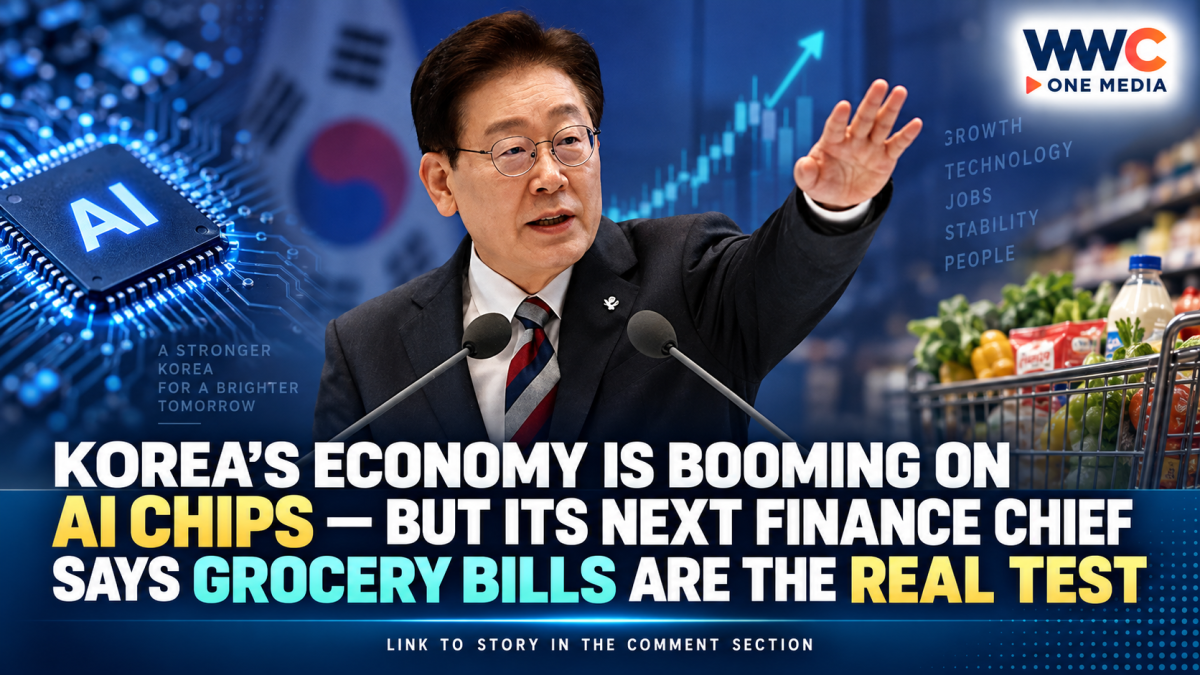
SEOUL — South Korea may be racing toward a historic $40,000 per-capita income milestone, powered by extraordinary semiconductor exports and artificial-intelligence investment, but the man nominated to become the country’s next finance minister says the headline numbers will mean little if ordinary households keep struggling with prices.
Finance Minister nominee Lee Hyoung-il told lawmakers at his confirmation hearing Tuesday that controlling inflation and ensuring Korea’s economic rebound reaches household finances would be among his top priorities if he takes office.
Lee acknowledged that Asia’s fourth-largest economy is showing increasingly convincing signs of recovery, particularly as global demand for artificial intelligence drives a semiconductor boom.
But he also delivered a warning: Korea’s impressive growth numbers are arriving alongside stubborn consumer-price pressures, geopolitical uncertainty and a global trade environment that could turn quickly.
“Growing demand for AI services has led to a semiconductor boom,” Lee told the National Assembly, pointing to improving exports and investment.
Yet his message was not simply that Korea should celebrate.
The bigger challenge, he argued, is making sure the recovery is something families can actually feel.
Inflation has climbed back above 3%
That concern is grounded in Korea’s latest inflation data.
Consumer prices rose 3.1% in August from a year earlier, accelerating from 2.8% in July.
Higher fuel costs were a major contributor. Petroleum-product prices jumped 14.2% year on year, with diesel up 19.6% and gasoline 11.5%.
There was an unusual factor in the August number: mobile-phone charges surged because of comparisons with temporary discounts offered a year earlier.
The Finance Ministry estimated inflation would have been closer to 2.5% without that base effect.
That provides some reassurance — but it does not eliminate the problem.
The Bank of Korea said underlying inflation remains elevated, with core consumer prices excluding volatile food and energy advancing 3.4% in August, the fastest pace since May 2023.
For policymakers, that is the uncomfortable part.
Some of August’s inflation can be explained away statistically.
The pressure households feel at supermarkets and fuel stations cannot.
Lee says food and fuel prices come first
Lee told lawmakers that stabilizing consumer prices would be the “first step” toward reducing economic disparities.
He specifically promised efforts to ease grocery costs and stabilize prices for agricultural products, livestock, fisheries and fuel.
That focus is consistent with what Lee has been saying since President Lee Jae Myung nominated him for the finance portfolio on August 30.
Earlier this month, he described prices of daily necessities as effectively the government economic team’s “report card,” arguing that inflation hits lower-income and vulnerable households disproportionately hard.
Lee has direct experience with that problem.
As first vice finance minister, he was involved in administering Korea’s fuel-price cap system as Middle East disruptions pushed energy costs higher. He is a longtime economic bureaucrat who has served as head of Statistics Korea, deputy finance minister, a presidential economic-policy secretary and an economist at the World Bank.
If confirmed and appointed, he would inherit an economy whose strongest growth engine is simultaneously one of its biggest vulnerabilities.
Korea’s chip exports are exploding
The scale of the semiconductor boom is remarkable.
South Korea reported $98.25 billion of exports in August, up 68.7% from a year earlier, according to the Ministry of Trade, Industry and Resources.
Semiconductor exports alone hit a record $46.65 billion, surging 209% year on year as hyperscalers such as Google and Amazon continued pouring money into AI infrastructure.
Non-semiconductor exports also rose 20%.
The AI cycle has become powerful enough for the Bank of Korea to sharply upgrade its economic outlook.
In August, the central bank raised its forecast for 2026 GDP growth to 3.3% from 2.6%, saying exports and investment were expanding faster than previously expected as the semiconductor boom spread through the broader economy.
Growth of 2.9% is projected for 2027.
That is the good news Lee wants to preserve.
The risk is that Korea becomes too dependent on one spectacularly strong industry.
What happens if the AI cycle cools?
Lee specifically warned that Korea must maintain macroeconomic stability despite possible volatility in the semiconductor cycle.
That concern is increasingly important.
Samsung Electronics and SK Hynix are benefiting enormously from demand for advanced memory used in AI servers, while investment in semiconductor factories and related infrastructure is accelerating.
SK Hynix alone approved about 54.3 trillion won ($38.3 billion) of investment through 2031 for major production facilities in Yongin and Cheongju.
But semiconductor markets are famously cyclical.
Today’s shortage can become tomorrow’s excess capacity.
AI companies could slow capital expenditure, memory prices could weaken or geopolitical restrictions could disrupt trade.
The Bank of Korea itself identifies both the semiconductor cycle and Middle East developments as major uncertainties surrounding its growth forecast.
Lee’s challenge would therefore be to make the recovery more durable before the chip cycle eventually turns.
Korea may cross the $40,000 income line
One headline statistic captures both the progress and the problem.
South Korea is on course for gross national income per person to exceed $40,000 in 2026 for the first time, according to recent Bank of Korea data and government estimates.
Nominal GDP grew an extraordinary 26.4% year on year in the second quarter, the strongest pace in 47 years, with AI-related exports playing a major role.
Lee highlighted the impending $40,000 milestone during his hearing.
Symbolically, it would place Korea deeper among the world’s high-income economies after spending more than a decade in the $30,000 range.
But per-capita GNI is not the same thing as the salary of the average Korean worker.
It includes income accruing to corporations, households and government, making it entirely possible for the national number to climb rapidly while individual households still feel financially squeezed.
That is why the inflation issue matters politically as much as economically.
A nation can statistically become richer while voters feel poorer.
The Bank of Korea is already fighting inflation
Lee will also have to work alongside a central bank that has already begun tightening monetary policy.
On August 27, the Bank of Korea raised its benchmark rate by 25 basis points to 3.00%, its second consecutive increase.
The central bank said stronger-than-expected growth and persistently elevated inflation meant preventive action was needed before price pressures became more widespread.
That creates another policy balancing act.
Higher interest rates can cool inflation.
But they also increase borrowing costs for households and businesses.
Korean households are already highly sensitive to interest rates because of substantial mortgage and property-related debt.
So while the Finance Ministry tries to make households feel the benefits of economic growth, monetary policy may simultaneously be making loans more expensive.
Middle East turmoil is another wild card
Lee also singled out the Middle East conflict as a major external threat.
That is particularly significant for South Korea because the country depends heavily on imported energy.
A sustained rise in international oil prices can quickly feed into fuel, transportation, manufacturing and food-distribution costs.
The Bank of Korea’s latest policy assessment similarly identified Middle East developments as a major source of uncertainty for global growth and inflation.
For Lee, that means domestic inflation policy can only go so far.
Seoul cannot control wars or global oil prices.
What it can control is how quickly those shocks reach household bills, how effectively the government manages emergency supply measures and whether fiscal support is targeted without adding even more inflationary pressure.
Lee is not promising tax cuts to solve the problem
Ahead of his hearing, Lee also clarified several important elements of his broader economic philosophy.
He said another corporate-tax cut is not under consideration, noting that Korea restored its top corporate rate from 24% to 25% this year.
He argued that additional revenue should help support corporate competitiveness while maintaining a healthier relationship between growth and public finances.
At the same time, Lee has said an active fiscal role remains necessary to tackle structural problems and external shocks — though it must be balanced against long-term fiscal sustainability.
His position on financial taxation is more cautious.
He said a financial-investment income tax should be reviewed only after markets are sufficiently stable, while planned taxation of cryptocurrency income is expected to proceed next year, with detailed rules due before year-end.
Those positions suggest Lee is likely to pursue a fairly orthodox technocratic approach: support growth where necessary, but avoid policies that could destabilize prices, markets or public finances.
And he wants Korea promoted by MSCI
Another major task on Lee’s agenda is one Korea has unsuccessfully pursued for years: promotion to developed-market status in MSCI’s global indexes.
MSCI again kept South Korea classified as an emerging market in June.
The index provider acknowledged Seoul’s reforms but said longstanding accessibility problems remain unresolved — particularly the fact that the Korean won is not freely deliverable offshore and that liquidity during extended foreign-exchange trading hours is still insufficient.
Lee told lawmakers that the Finance Ministry would continue working toward an MSCI upgrade while advancing the internationalization of the won.
The long-term aim is to make Korea’s currency easier to hold, borrow and trade outside the country.
An MSCI upgrade could eventually attract more international capital to Korean equities because funds tracking developed-market indexes would need to reconsider their allocations.
But MSCI has repeatedly signaled that structural market access matters more than simply Korea’s wealth or economic sophistication.
Crossing $40,000 per capita will not, by itself, be enough.
The contradiction Lee inherits
The numbers surrounding South Korea right now seem almost incompatible.
Exports are setting records.
AI demand is driving a historic semiconductor boom.
The Bank of Korea expects 3.3% growth.
Per-capita GNI could cross $40,000.
Yet inflation is above 3%, core price pressures remain stubborn and the central bank has already raised interest rates twice in succession.
That is why Lee Hyoung-il’s confirmation-hearing message matters.
The incoming economic team is not being asked simply to create growth.
Korea already has growth.
Its harder task is turning an AI-and-chip-driven boom into something consumers can feel before inflation, oil shocks or another turn in the semiconductor cycle erodes the gains.
And that leads to the question that could define Lee’s tenure as finance minister:
If South Korea becomes a $40,000-per-person economy this year, will ordinary Koreans actually feel $40,000 richer — or will grocery bills, fuel prices and higher interest rates tell them a very different story?




Leave a Reply