
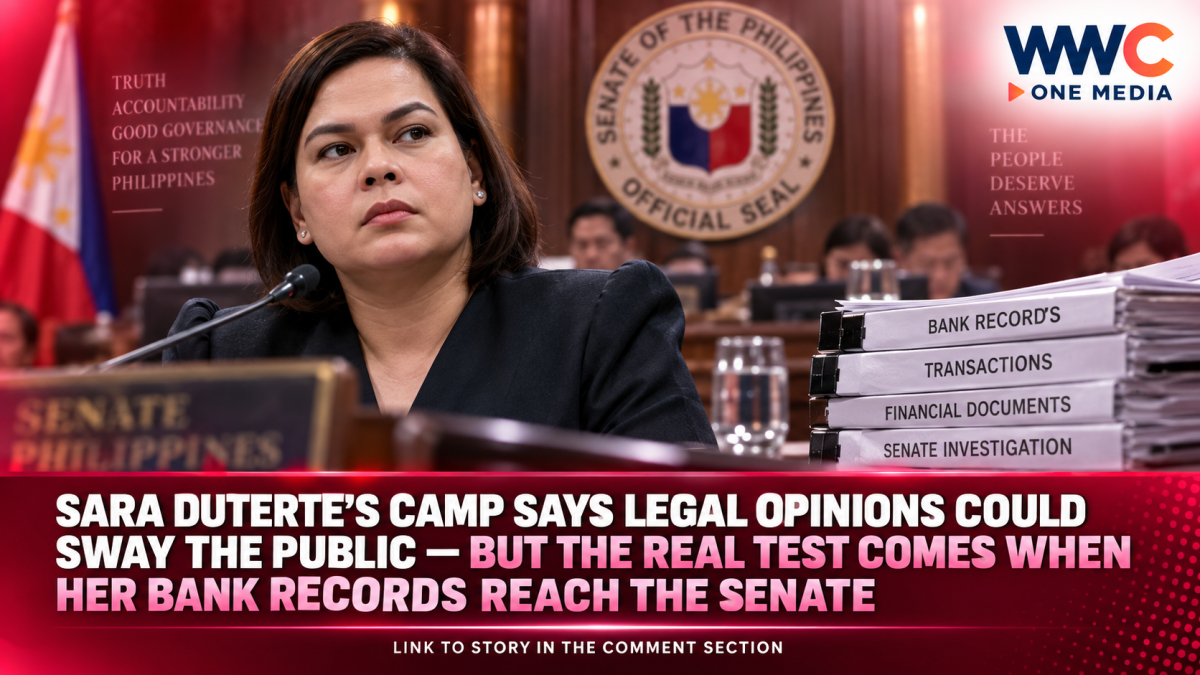
MANILA, Philippines — Vice President Sara Duterte’s defense team is warning that legal opinions aired during her nationally televised impeachment trial could influence the public before senator-judges have ruled on the evidence — opening a new battle not simply over what the law says, but over who should be allowed to explain it inside the impeachment court.
The dispute erupted as the Senate began hearing Article II of Duterte’s impeachment case, which accuses her of accumulating unexplained wealth, failing to fully disclose assets and financial interests, and maintaining business interests while serving as vice president.
Duterte has denied wrongdoing, and the Senate impeachment court has made no final factual finding that she accumulated unexplained wealth, filed false Statements of Assets, Liabilities and Net Worth, or violated constitutional restrictions on business participation.
At the center of the latest clash is retired Sandiganbayan Presiding Justice Amparo Cabotaje-Tang, whom House prosecutors presented as an expert on public accountability, anti-corruption laws, unexplained wealth and SALN requirements.
Duterte’s lawyers tried to stop her testimony.
The Senate let her speak anyway.
But it attached a crucial qualification:
Her legal opinion is not the verdict.
Duterte camp: The senator-judges should interpret the law themselves
Defense lawyer Mark Vinluan argued that Cabotaje-Tang’s testimony risked crossing the line between expert explanation and legal conclusions that properly belong to the senator-judges.
Vinluan’s position was that the Senate impeachment court itself must determine how the law applies to Duterte — not a prosecution witness.
The defense also warned that allowing a former senior anti-graft magistrate to explain potentially incriminating legal concepts before the prosecution had finished presenting the underlying evidence could help condition public opinion against the vice president.
That concern is the heart of the Manila Standard report.
The defense is not arguing that lawyers or retired judges must remain silent about the law.
It is arguing that, in a nationally watched political trial, an authoritative-sounding legal interpretation can be perceived by the public as a judicial conclusion even when the actual decision-maker has reached no such conclusion.
And in an impeachment trial with obvious consequences for Duterte’s political future, public perception matters far beyond the Senate chamber.
Escudero drew a line: She can explain, but she cannot bind the court
Presiding Officer Francis “Chiz” Escudero rejected the defense bid to exclude Cabotaje-Tang.
But his explanation significantly limited what the prosecution could claim her testimony means.
Escudero said that although Cabotaje-Tang may qualify as an expert, whatever she says is not binding on the impeachment court and her opinion is not conclusive.
The defense remains free to cross-examine her and may present its own witness to dispute her interpretations.
That may be the most important legal distinction in the entire controversy.
Cabotaje-Tang can tell senators how anti-graft statutes have been interpreted.
She can explain what an SALN is supposed to contain.
She can discuss the legal concept of unexplained wealth.
But she cannot decide whether Sara Duterte’s particular assets, transactions or financial disclosures satisfy those definitions.
Only the senator-judges can ultimately do that.
The Constitution gives the Senate the sole power to try and decide impeachment cases, and conviction requires the concurrence of two-thirds of all senators.
Why prosecutors wanted a former Sandiganbayan chief on the stand
House prosecutor Chel Diokno defended the decision to call Cabotaje-Tang, saying the laws governing public accountability and unexplained wealth involve concepts that are unfamiliar even to many lawyers, much less non-lawyers.
The prosecution argues that her testimony establishes the legal framework senator-judges can use when the financial records are presented.
Article II is fundamentally different from allegations involving a public statement, video clip or single government transaction.
It requires senators to compare multiple financial data points — income, assets, liabilities, SALNs, bank records, corporate interests and potentially expenditures — and determine whether the prosecution has established a meaningful discrepancy.
That is why prosecutors say the witness matters.
Before asking senators to examine the numbers, they want someone with decades of anti-graft experience to explain what those numbers legally could — and could not — mean.
Cabotaje-Tang spent decades inside the anti-graft system
Cabotaje-Tang is not an ordinary legal commentator.
She retired in 2024 after a career spanning approximately 44 years in government legal and anti-corruption work, including service in the Office of the Solicitor General, the Supreme Court and ultimately the Sandiganbayan, where she became presiding justice.
That résumé is precisely why prosecutors consider her testimony powerful.
It is also precisely why Duterte’s defense is wary of its effect on viewers.
A retired presiding justice explaining that certain financial circumstances can justify removal from public office naturally carries greater rhetorical weight than the same proposition coming from a partisan spokesperson.
But institutional experience does not transform an expert opinion into a ruling on Duterte.
Escudero made that clear.
What she actually said about unexplained wealth
During her testimony, Cabotaje-Tang explained that Philippine law provides mechanisms for dealing with wealth acquired by a public official that is manifestly disproportionate to lawful income.
Republic Act No. 1379 provides for forfeiture proceedings involving property allegedly acquired by public officials beyond what legitimate earnings could reasonably explain.
Separately, Section 8 of the Anti-Graft and Corrupt Practices Act, as amended, states that property or money acquired during incumbency that is manifestly out of proportion to salary and lawful income can constitute a basis for dismissal or removal when the statutory requirements are satisfied.
There is an important limitation.
Merely showing that a public official has substantial wealth is not enough.
The analysis must consider lawful income, assets accumulated before the period involved, legitimate business earnings and other lawful financial sources.
A 2025 Supreme Court ruling emphasized that determining unexplained wealth requires a sufficiently complete analysis of an official’s earnings and financial history, not an incomplete comparison that ignores legitimate income.
That nuance matters enormously in Duterte’s trial.
The prosecution still has to prove its allegations using actual evidence.
SALNs are becoming one of the trial’s central battlegrounds
Under Republic Act No. 6713, government officials generally must disclose assets, liabilities, net worth and financial or business interests.
The law specifically covers categories including real property, personal property, investments, cash on hand or in banks, stocks and bonds, liabilities and business interests.
Prosecutors accuse Duterte of failing to fully and truthfully disclose assets and financial interests in SALNs covering 2022, 2023 and 2024.
They also allege that she continued certain business interests while serving as vice president from 2022 onward.
Those remain prosecution allegations.
Duterte’s defense disputes the impeachment charges, and no final determination has been reached.
The Constitution imposes unusually strict rules on the president and vice president
Part of Article II also concerns an issue different from unexplained wealth: participation in private business.
Article VII, Section 13 of the 1987 Constitution says the president and vice president may not, while in office, directly or indirectly participate in any business or be financially interested in certain government contracts, franchises or special privileges.
They are also required to strictly avoid conflicts of interest.
Supreme Court jurisprudence has described those constitutional restrictions as particularly broad compared with restrictions applying to many other public officials.
But another legal question immediately follows:
Does merely owning shares constitute prohibited “participation” in a business, or must there be some level of active involvement?
That became part of Monday’s debate as senators and lawyers tested Cabotaje-Tang’s interpretation.
The answer could matter greatly when the defense begins applying the law to Duterte’s actual interests.
The defense even brought President Marcos’ SALN into the argument
Duterte’s lawyers attempted to test Cabotaje-Tang’s legal interpretation by raising financial interests disclosed by President Ferdinand Marcos Jr. in a SALN.
The defense said the point was to challenge or examine the consistency of the witness’s legal position, rather than simply inject another political figure into Duterte’s case.
The episode underscored why the defense objects to broad legal conclusions before specific facts are examined.
The same words — “ownership,” “financial interest,” “business participation” — can lead to different legal arguments depending on what a public official actually did with the asset or company involved.
Cabotaje-Tang also corrected herself on one important SALN point
The hearing demonstrated that even expert testimony is subject to challenge.
Senator-Judge Raffy Tulfo asked Cabotaje-Tang about large amounts of money allegedly passing through a public official’s bank account but disappearing before the SALN reporting date.
Cabotaje-Tang initially discussed the obligation to report money held in an official’s account.
But after a senator pointed out that an SALN reflects financial position as of December 31, she acknowledged the distinction.
Money that entered and left an account months earlier would not necessarily appear as an asset on the December 31 SALN simply because it had once passed through the account.
The transactions could still be relevant for other investigative purposes, she said, including examination of bank or anti-money-laundering records.
That exchange actually reinforces the defense’s larger point in one respect:
General legal principles have to be matched carefully to dates, documents and facts.
They cannot substitute for the financial evidence itself.
The prosecution’s response: That is exactly why cross-examination exists
From the prosecution’s perspective, none of this means Cabotaje-Tang should have been prevented from testifying.
The expert gives an opinion.
The defense challenges it.
Senators ask questions.
And the impeachment court gives the testimony whatever weight it believes is appropriate.
Escudero explicitly permitted the defense to maintain a continuing objection and told Duterte’s lawyers they could present their own expert witness if they wanted to rebut Cabotaje-Tang.
That is significant because it means the impeachment court did not adopt the prosecution witness’s interpretations as official law governing the case.
It allowed a competing process.
The cross-examination quickly became personal
Duterte’s lawyers did not confine their attack to legal doctrine.
Vinluan asked Cabotaje-Tang whether she was anti-Duterte, whether she identified with supporters of former Vice President Leni Robredo and whether her failure to secure a Supreme Court appointment during Rodrigo Duterte’s presidency affected her views.
Cabotaje-Tang denied being anti-Duterte and said she had been apolitical throughout her life.
When Vinluan asked whether she had been offered anything in exchange for appearing, the retired justice responded that she would refuse to testify if anything material had been offered.
“My testimony is not for sale,” she told the impeachment court.
The defense was entitled to probe credibility and possible bias.
The prosecution, meanwhile, later accused Duterte’s lawyers of attempting to “sabotage” the witness’s credibility.
Those competing characterizations should be treated as advocacy from opposing sides — not factual conclusions about either the defense or the witness.
The real fight begins when the bank records arrive
The legal debate surrounding Cabotaje-Tang may ultimately prove secondary to the documents themselves.
The Senate impeachment court previously granted subpoenas covering financial and tax records after finding that the requested materials were sufficiently specific, relevant and material to Article II.
House prosecutors later said they had received substantial bank and tax records involving Duterte, her husband and their companies.
More records are still coming.
The impeachment court ordered Philippine National Bank and UnionBank to provide additional Duterte bank records by September 17, granting the banks an extension because of the volume of material involved. Escudero said that deadline would not be extended again.
The prosecution has also submitted 104 requests for admission, asking Duterte to confirm the authenticity of subpoenaed bank documents and whether specified accounts belong to her individually or jointly with others.
That could make the next stage of Article II substantially more evidence-heavy than Monday’s legal debate.
And that is why the defense is worried about sequence
The Duterte camp’s complaint about public opinion makes more sense when viewed against that timeline.
The former Sandiganbayan chief explained what may legally count as unexplained wealth before the Senate had completed hearing and weighing the prosecution’s detailed financial evidence.
To Duterte’s lawyers, that creates a danger that viewers will hear a respected former judge explain the law and prematurely conclude that she was describing Duterte personally.
To prosecutors, the sequence is logical: explain the legal rules first, then introduce records showing why those rules allegedly apply.
Both positions have an intelligible procedural rationale.
Neither determines the eventual verdict.
There is also a much bigger political audience outside the Senate
This is an impeachment trial, not an ordinary criminal case.
Sara Duterte remains vice president while the proceedings continue, and her political future is tied directly to the result.
That makes the “court of public opinion” unusually important even though the formal decision belongs exclusively to senator-judges.
Earlier in the trial, Duterte’s own defense highlighted polling showing her with a positive public-trust rating.
When lawyer Mark Vinluan asked NBI Director Melvin Matibag whether those survey results affected the bureau’s investigation, Matibag said they did not, describing polling as only a snapshot and saying investigations must be based on law, evidence and procedure.
The two episodes reveal an interesting tension.
Duterte’s defense has invoked favorable public opinion when challenging prosecution witnesses.
Now it is simultaneously warning that prosecution testimony should not be allowed to unfairly shape that same public opinion.
That does not necessarily make either argument legally inconsistent — a defense team can cite polling while also objecting to allegedly prejudicial testimony — but it illustrates how central public perception has become to the impeachment battle.
Only the senator-judges can turn an opinion into a consequence
The constitutional structure ultimately cuts through much of the rhetoric.
The House prosecutes.
Duterte’s lawyers defend her.
Experts may explain.
Witnesses may testify.
Commentators may argue.
Pollsters may measure public sentiment.
But under Article XI of the Constitution, the Senate alone tries and decides the impeachment case.
Cabotaje-Tang’s testimony therefore cannot remove Sara Duterte from office.
Neither can a television commentary, viral video, favorable survey or unfavorable headline.
For the Article II charge to become politically decisive, prosecutors still need to connect their legal theory to actual financial evidence strongly enough to persuade the constitutionally required number of senator-judges.
And the defense still has the opportunity to challenge those records, explain the transactions, attack the prosecution’s calculations, present its own witnesses and offer competing interpretations.
The biggest unanswered question is no longer what the law says
The Philippines already has laws dealing with SALNs, unexplained wealth, conflicts of interest and financial disclosure.
Monday’s hearing largely explained those rules.
The real question now is much harder:
What do Sara Duterte’s actual financial records show when those rules are applied to them?
The prosecution says the bank and tax documents will help reveal the “whole picture.”
The defense says legal opinions should not be allowed to paint that picture before the evidence does.
The Senate has effectively taken a middle position.
It allowed the expert to speak.
But it also made clear that she cannot decide the case.
And as Article II moves from legal definitions to bank records, SALNs and transaction histories, that distinction may become increasingly important.
Because the impeachment trial is entering the stage where arguments about what unexplained wealth means will give way to the far more consequential question:
whether prosecutors can prove Sara Duterte actually had any.



Leave a Reply