
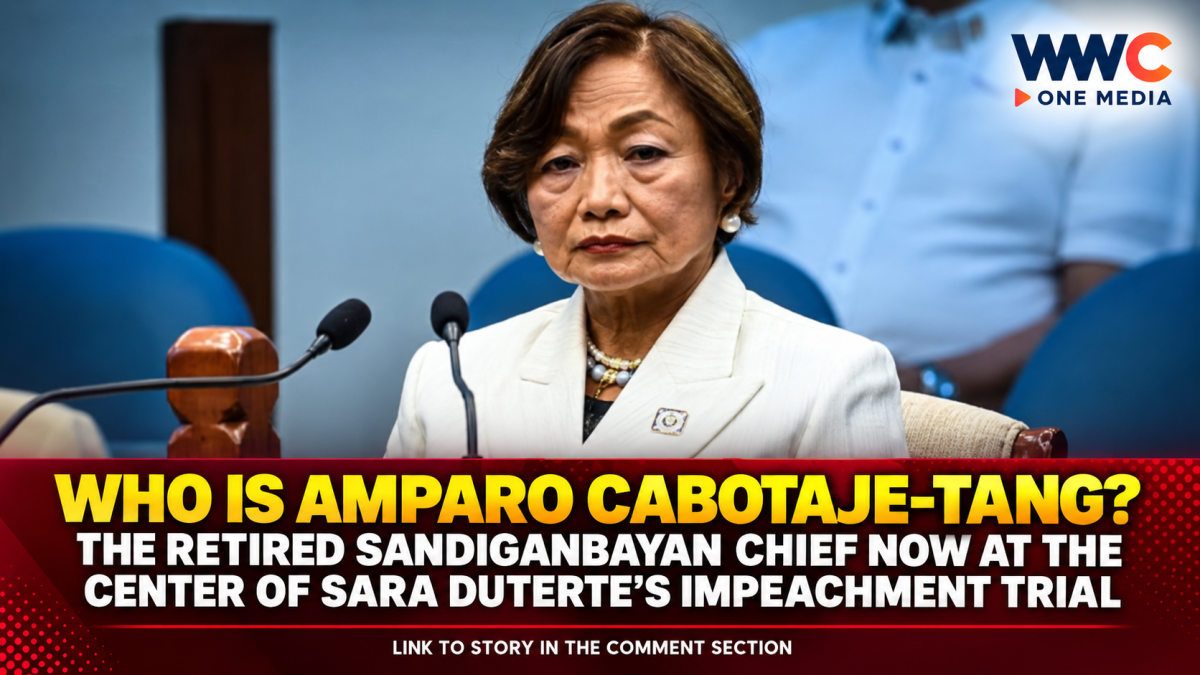
MANILA, Philippines — A retired anti-graft court chief has suddenly become one of the most closely watched figures in Vice President Sara Duterte’s impeachment trial.
Former Sandiganbayan Presiding Justice Amparo M. Cabotaje-Tang took the witness stand on September 14 as the prosecution opened its presentation of evidence on Article II, which involves allegations concerning unexplained wealth, inaccurate or incomplete Statements of Assets, Liabilities and Net Worth (SALNs), and prohibited business interests.
But who exactly is Cabotaje-Tang — and why did prosecutors turn to a retired justice to explain the legal principles behind one of the most politically sensitive portions of the impeachment case?
A career spanning the OSG and Sandiganbayan
Cabotaje-Tang is a veteran lawyer and jurist whose government career spans several decades.
According to the Supreme Court, she graduated from San Beda College of Law in 1979 and passed the Bar examinations that same year. She initially worked as a judicial assistant at the Supreme Court before joining the Office of the Solicitor General (OSG), where she eventually became an Assistant Solicitor General.
Her legal career later brought her to the Sandiganbayan, the Philippines’ special anti-graft court.
She was appointed to the Sandiganbayan in 2012 and eventually became its presiding justice. She retired from the judiciary in November 2024. During a retirement tribute, Chief Justice Alexander Gesmundo described her as a jurist committed to deciding cases based on facts, evidence, law and jurisprudence, without fear or favor.
Beyond the judiciary, Cabotaje-Tang also had an academic career. She has taught law at San Beda University and the University of Santo Tomas, with a specialization in criminal law, and served as a Bar examiner in Political Law in 2015.
Why is she testifying in Sara Duterte’s impeachment trial?
Cabotaje-Tang was presented by the House prosecution as an expert who could provide the impeachment court with a legal framework for understanding issues surrounding public accountability, unexplained wealth, SALNs and prohibited business interests.
The prosecution had asked the Senate impeachment court to subpoena Cabotaje-Tang along with officials who could authenticate records from the Ombudsman and Securities and Exchange Commission. Prosecutors said her testimony would help explain the legal and institutional principles involved in undisclosed or unexplained wealth and prohibited business interests.
Her testimony came as the impeachment court began examining Article II, which prosecutors are presenting through financial, banking, tax, corporate and other government records.
Philstar reported that the prosecution is pursuing three broad components under Article II: alleged unexplained wealth, alleged SALN violations, and alleged failure to declare or divest business interests.
Importantly, these remain allegations in an impeachment proceeding. Cabotaje-Tang’s testimony does not itself establish that Duterte committed the alleged violations.
Defense calls her a surprise witness
Cabotaje-Tang’s appearance immediately triggered a procedural fight.
Duterte’s defense objected to her testimony, arguing that she was not identified in the pre-trial order as a witness and that the defense had not been given sufficient information to prepare for her testimony.
Defense lawyer Mark Vinluan described her as a “surprise witness” and argued that allowing her to testify could raise concerns about fair play and due process.
The impeachment court, however, rejected the defense effort to exclude her. The court held that the pre-trial order allowed the prosecution to present additional witnesses and that the defense could challenge her qualifications and testimony through cross-examination.
‘My testimony is not for sale’
The cross-examination quickly became political as well as legal.
Vinluan questioned Cabotaje-Tang about her alleged political leanings, including whether she was anti-Duterte or associated with the Akbayan party-list group.
Cabotaje-Tang denied being politically aligned against Duterte and said she had never been political.
The defense also questioned her relationship with prosecutor Chel Diokno. Cabotaje-Tang explained that she knew Diokno from their time at the OSG, where they had been on opposing sides in legal cases.
When asked whether she had been offered anything in exchange for her testimony, Cabotaje-Tang gave one of the day’s most widely reported responses: “My testimony is not for sale.”
She maintained that she appeared because she had been subpoenaed.
What did Cabotaje-Tang tell the impeachment court?
Much of her testimony focused on the legal principles governing public officials’ assets and business interests.
Cabotaje-Tang told the court that unexplained wealth can have serious consequences under Philippine anti-graft laws. She discussed Republic Act No. 3019, the Anti-Graft and Corrupt Practices Act, as well as Republic Act No. 1379, which concerns unlawfully acquired property.
She also explained issues surrounding SALNs and the declaration of assets belonging to spouses.
According to Philstar’s account of the proceedings, Cabotaje-Tang said a public official generally has an obligation to include a spouse’s assets in the official’s SALN, subject to applicable legal exceptions such as a valid agreement for complete separation of property entered into before marriage.
She further told the court that intentional concealment can have consequences, while acknowledging that circumstances can matter — including situations where an official genuinely did not know about a particular joint account or asset.
The business-divestment issue
Another major portion of the testimony involved whether high-ranking government officials can continue participating in business while in office.
Cabotaje-Tang told the impeachment court that the constitutional restrictions on the President and Vice President are designed to prevent conflicts of interest and potential abuse of official power.
She said the prohibition extends beyond simply managing a company and can cover direct or indirect participation, including ownership or serving as a corporate director.
She also said the Constitution requires the President and Vice President to divest from business interests within the prescribed period after assuming office.
That issue is particularly significant because prosecutors have identified alleged failure to divest from business interests as one of the components of Article II.
Why her background matters
Cabotaje-Tang’s importance to the proceedings comes largely from her professional background.
She spent decades working in government legal service and later served on the country’s specialized anti-graft court. The Supreme Court has also highlighted her involvement in legal reform and her work in legal education.
That background is precisely why the prosecution wants her testimony to serve as a framework for the financial and corporate documents expected to follow.
Philstar reported that prosecutors intend to use her testimony to help the court and the public understand the significance of records involving bank accounts, taxes, corporations and declared assets.
But the defense is challenging more than her testimony
The defense has not only questioned Cabotaje-Tang’s qualifications. It has also attempted to challenge her objectivity and political neutrality.
Among the issues raised during cross-examination were her previous non-appointment to the Supreme Court under former President Rodrigo Duterte, her relationship with Diokno and whether she had political sympathies opposed to the Duterte family.
Cabotaje-Tang rejected the implication that her testimony was politically motivated. She also said she was not disappointed that she was not appointed to the Supreme Court, describing such an appointment as the President’s prerogative.
A pivotal witness — but not the final word
Cabotaje-Tang’s appearance marks an important transition in the impeachment proceedings.
The trial is now moving into the detailed examination of the financial and business allegations contained in Article II. Prosecutors are expected to present additional witnesses and documentary evidence concerning bank records, SALNs, government records and corporate interests.
Cabotaje-Tang’s role is therefore less about proving a particular financial transaction and more about explaining what Philippine law requires public officials to declare, what constitutes prohibited participation in business, and how unexplained wealth is treated under existing laws.
The defense, meanwhile, is expected to continue attacking both the prosecution’s evidence and the relevance or credibility of its witnesses.
For now, Amparo Cabotaje-Tang’s return to the national spotlight represents a striking second chapter in the career of a former anti-graft court chief: after decades of working inside the Philippine justice system, she is now explaining its legal principles before the Senate impeachment court in one of the country’s most consequential political proceedings.



Leave a Reply