
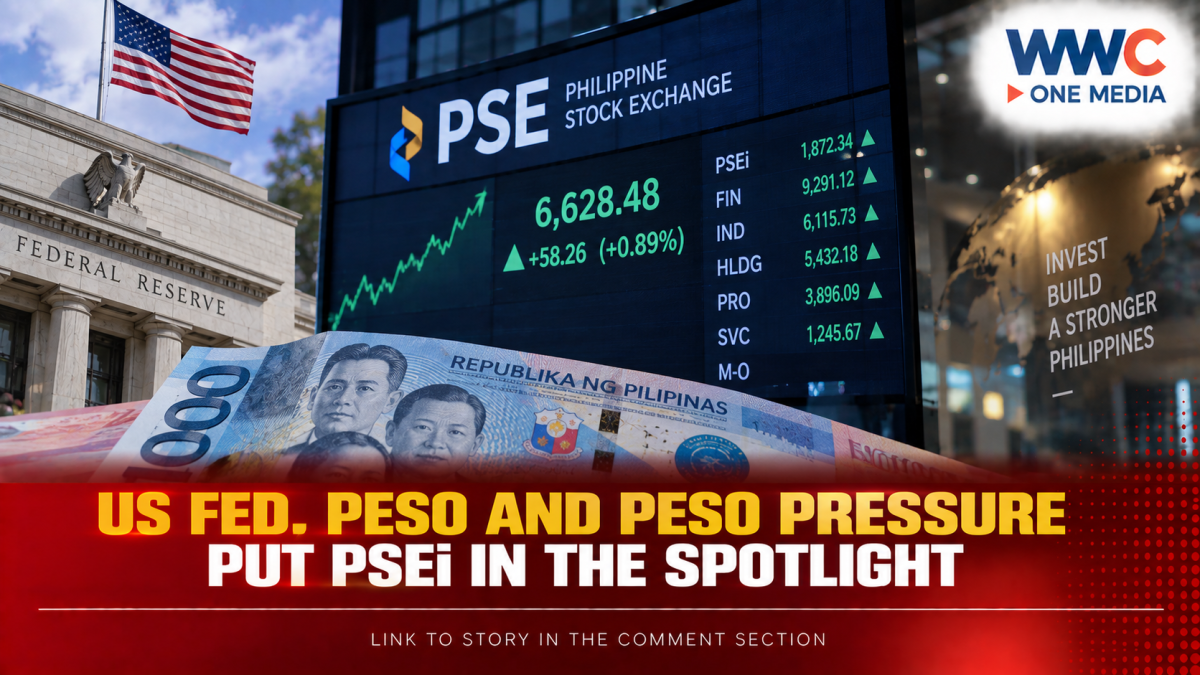
MANILA — Philippine stocks face another potentially volatile week as investors weigh two major forces: the direction of U.S. Federal Reserve policy and the continuing weakness of the Philippine peso.
The Philippine Stock Exchange index (PSEi) is entering a crucial stretch with investors watching the Federal Reserve’s Sept. 15–16 policy meeting, movements in the peso-dollar exchange rate and renewed inflation concerns linked to higher global oil prices.
Analysts cited by The Philippine Star said investors could remain cautious and trading could stay thin as markets wait for clarity from the U.S. central bank. F. Yap Securities said a potential Fed rate increase could put additional pressure on emerging Asian markets, including the Philippines.
But the Fed decision is far from a foregone conclusion.
Fed uncertainty keeps investors on edge
The Federal Reserve has become a major focus for global investors because U.S. interest-rate decisions influence borrowing costs, bond yields, currency movements and the flow of international capital.
Reuters reported that a majority of economists surveyed expected the Fed to keep its policy rate at 3.50%–3.75% at the September meeting and through the end of 2026. However, uncertainty has increased, with a growing number of analysts anticipating at least one rate hike later this year.
Market expectations have also shifted as U.S. inflation remains above the Fed’s 2% target and oil prices have risen sharply.
UBS, for example, recently changed its forecast and projected two Fed rate increases in 2026, including one in September and another in December, following stronger labor-market data and renewed inflation concerns.
That uncertainty could translate into more volatility for Asian equities.
Why the peso matters for Philippine stocks
The other major factor is the Philippine peso.
The currency has remained under pressure against the U.S. dollar, with the peso reaching a record-low close of ₱62.590 per dollar on Sept. 4, according to the Philippine Tribune.
MUFG also recently raised its near-term USD/PHP forecast, pointing to the peso’s move above the ₱62 level, higher oil prices and elevated U.S. yields as factors affecting the currency. The bank expects USD/PHP to remain around ₱62 during the second half of 2026 before potentially moving lower in the first half of 2027.
A weaker peso can create mixed effects.
Exporters and companies receiving dollar revenues may benefit from a weaker currency when those earnings are converted into pesos. But businesses that depend heavily on imported goods, fuel or dollar-denominated obligations can face higher costs.
For investors, meanwhile, a weaker peso can make Philippine assets less attractive when measured against foreign currencies, particularly if U.S. yields remain high.
Oil prices add another layer of risk
The currency story is also closely connected to energy prices.
Rising global oil prices can worsen the Philippines’ import bill and increase inflationary pressure. BusinessWorld and the Manila Times recently warned that the combination of a weaker peso and higher oil prices could weigh on Philippine equities by reviving concerns about inflation and economic growth.
The international backdrop has become even more complicated because of geopolitical tensions affecting energy supplies.
Reuters reported that Asian markets fell sharply as oil prices climbed and investors increasingly anticipated tighter monetary policy in the United States and Japan.
Can the PSEi still recover?
Despite the risks, analysts are not uniformly bearish on Philippine stocks.
BusinessWorld previously reported that COL Financial saw a possibility of the PSEi reaching 7,500 by year-end under a supportive scenario, while more recently Philstocks Financial projected a 2026 year-end range of 6,241 to 6,487. Those forecasts demonstrate how widely market expectations can differ depending on assumptions about earnings, interest rates and economic conditions.
The PSEi’s recent performance has nevertheless reflected the market’s caution. The Philippine Stock Exchange’s official market reports show continued monitoring of trading activity and index movements as investors navigate the current environment.
For Philippine investors, the immediate question is therefore not simply whether the Fed raises or holds rates.
It is what the Fed signals about the months ahead.
A hawkish message could keep U.S. yields and the dollar elevated, potentially putting further pressure on emerging-market currencies and equities. A less aggressive outlook, meanwhile, could provide some breathing room for markets such as the Philippines.
The bigger test for the PSEi
The PSEi is now caught between competing forces: global interest rates, the peso, oil prices, inflation and domestic economic growth.
If the peso continues weakening while global rates remain elevated, Philippine stocks could face another difficult period. But if inflation pressures stabilize and investors regain confidence in domestic earnings, the market could find room to recover.
The Fed’s decision may set the tone — but the peso could determine just how difficult the ride becomes for Philippine stocks.




Leave a Reply