
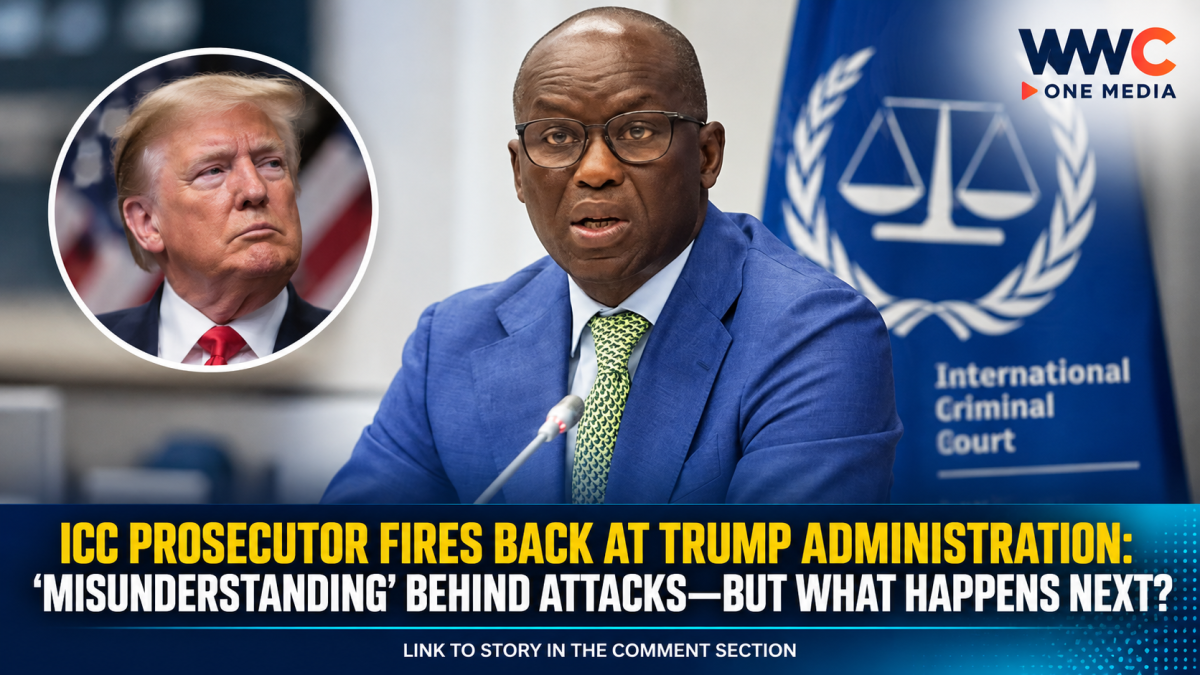
The International Criminal Court is pushing back against an escalating campaign from the administration of US President Donald Trump, with its interim chief prosecutor saying Washington’s criticism appears to be rooted in a fundamental misunderstanding of what the tribunal is designed to do.
Mame Mandiaye Niang, the Senegalese prosecutor currently serving as the ICC’s interim chief prosecutor, told AFP that the court has no intention of violating national sovereignty or acting as a global police force.
“We have no interest in, nor is it our role to, infringe upon state sovereignty,” Niang said, stressing that the ICC knows it is not “the world’s police.”
His comments come as the Trump administration continues to intensify pressure on the Hague-based court, including sanctions against senior ICC officials.
Washington vows to dismantle the ICC
US Secretary of State Marco Rubio has described the ICC as an “intolerable threat” to US sovereignty and has vowed to dismantle the institution “brick by brick.”
The confrontation has intensified particularly over the ICC’s investigation involving Israel and its arrest warrant for Israeli Prime Minister Benjamin Netanyahu. Washington has rejected the court’s authority over US and Israeli nationals because neither country is a party to the Rome Statute.
The United States has also imposed sanctions on several ICC officials.
In August, Washington sanctioned ICC President Tomoko Akane and senior trial lawyer Abdoulaye Seye, further escalating its campaign against the court. Reuters reported that the sanctions can freeze assets under US jurisdiction and restrict access to US-linked financial systems.
Niang himself is among ICC officials affected by US sanctions. He said the restrictions have made ordinary tasks—including accessing payment systems and arranging travel—extremely difficult.
But the prosecutor indicated that the ICC is preparing alternative technical and financial arrangements to keep its operations functioning if additional US sanctions are imposed.
ICC rejects accusations of corruption
Niang also pushed back against Washington’s characterization of the ICC as corrupt or politically motivated.
He said the court does not accept that assessment and insisted that its mandate is centered on accountability for the gravest international crimes.
The ICC was established under the Rome Statute to prosecute individuals accused of genocide, crimes against humanity, war crimes and aggression when the court has jurisdiction. The United States, along with Israel, Russia and China, is not a party to the Rome Statute.
The dispute therefore goes beyond one individual case. It has become a broader confrontation over the limits of international justice and the ability of an international court to investigate alleged crimes involving nationals of countries that do not recognize its jurisdiction.
Why the Philippines is watching closely
The ICC’s confrontation with Washington carries particular significance in the Philippines because the court is preparing for the trial of former President Rodrigo Duterte over alleged crimes against humanity linked to his administration’s anti-drug campaign.
The ICC says Duterte’s case concerns alleged crimes committed in the Philippines between November 1, 2011, and March 16, 2019. His arrest warrant was issued in March 2025, and he was surrendered to the court in The Hague days later.
In April 2026, ICC judges confirmed the charges against Duterte and committed him to trial. The ICC currently lists the opening of the trial for November 30, 2026.
The ICC Appeals Chamber also rejected Duterte’s challenge to the court’s jurisdiction in April, reinforcing the court’s position that the Philippines’ later withdrawal from the Rome Statute did not erase jurisdiction over alleged crimes committed while the country was still a member.
That distinction is important: the Philippines formally left the ICC in 2019, but the court maintains that withdrawal is not retroactive.
Duterte case enters a crucial phase
The dispute over the ICC’s authority is unfolding as preparations for Duterte’s trial accelerate.
Just days before Niang’s comments about the United States, his office opposed a request from Duterte’s defense team seeking stricter verification requirements for open-source and user-generated digital evidence.
The defense argued that the enormous volume of evidence in the case—including online materials—requires stronger safeguards because misinformation and fake news surrounding the proceedings could complicate verification.
The prosecution countered that requiring expert reports for every piece of open-source or user-generated material would be unnecessary and inefficient, arguing that verification should instead be assessed on a case-by-case basis.
Philippine news organizations reported that the defense said the evidence reviewed by the team had grown substantially and included material it considered poor quality or duplicative.
The ICC is facing pressure on several fronts
Niang’s comments come at one of the most turbulent periods in the ICC’s history.
The court is dealing with US sanctions, criticism over its investigations, and the departure of several member states.
The Associated Press reported that five countries—Venezuela, Chad, Burkina Faso, Mali and Niger—have announced plans to leave the ICC within the past year, adding to concerns about the future strength of the international justice system.
At the same time, the court has undergone a leadership crisis following the removal of former prosecutor Karim Khan.
In July, the Assembly of States Parties voted to remove Khan after disciplinary proceedings concerning allegations of serious misconduct. Khan has denied the allegations. The ICC said the proceedings were unrelated to the conduct of its investigations and proceedings.
Niang, who took over the prosecutor’s office on an interim basis, said the institution now needs stability and continuity while member states work toward choosing a permanent prosecutor.
‘Nothing’s impossible’
Despite the mounting pressure, Niang remains defiant.
He pointed to the Duterte case as evidence that even seemingly impossible prosecutions can eventually move forward.
He also expressed hope that other high-profile suspects subject to ICC arrest warrants—including Russian President Vladimir Putin and Netanyahu—could one day face proceedings before the court.
“Nothing’s impossible,” Niang told AFP.
For the ICC, however, the challenge is no longer simply whether individual cases can reach trial.
It is whether the institution can maintain its independence and operational capacity while facing sanctions from the world’s most powerful country, criticism from governments under investigation, withdrawals by member states and a leadership crisis of its own.
And with Duterte’s trial scheduled to begin in November, the Philippines is poised to become one of the most closely watched tests of whether the ICC can withstand the pressure.


Leave a Reply