
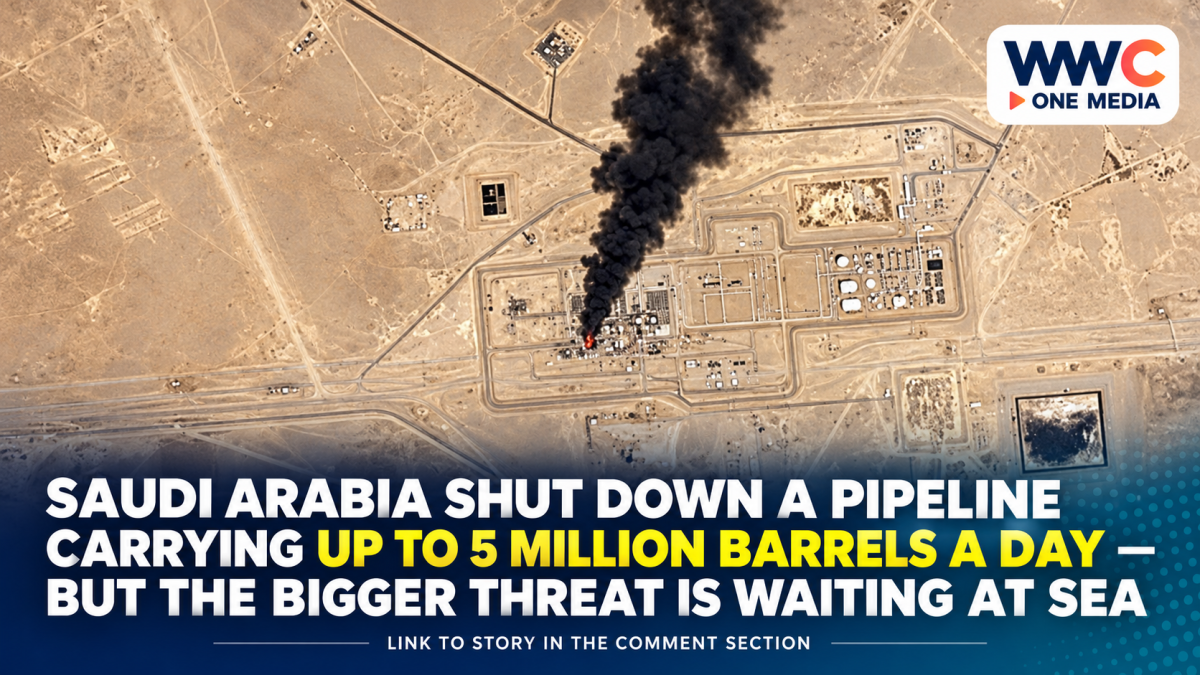
RIYADH/ADEN — Saudi Arabia has temporarily shut one of its most important oil pipelines after multiple aerial attacks, just as Iran-aligned Houthi forces make dramatic territorial gains near a maritime chokepoint carrying millions of barrels of oil each day.
The simultaneous pressure on Saudi Arabia’s land and sea export routes is raising fresh fears over global energy supplies, with oil prices already back above $100 a barrel amid the widening Middle East conflict.
Saudi Arabia’s Energy Ministry confirmed that its East-West Pipeline was struck multiple times on September 10 in the Riyadh and Madinah regions. Authorities shut the line as a precaution while technical teams assess its safety. The attacks caused injuries, although Saudi officials have not disclosed their number or announced the full extent of the damage.
Why This Pipeline Matters Far Beyond Saudi Arabia
The East-West Pipeline, also known as Petroline, stretches roughly 1,200 kilometers across Saudi Arabia, moving crude from the kingdom’s oil-producing east to the Red Sea port of Yanbu.
Its strategic importance has surged during the current crisis because it allows Saudi Arabia to bypass the Strait of Hormuz — the Persian Gulf chokepoint where shipping has been severely disrupted by the U.S.-Iran conflict.
Reuters reported that the pipeline had recently been moving roughly 4 million to 5 million barrels of oil per day, equivalent to about 4% to 5% of global supply. Saudi Arabia restored the system to a maximum pumping capacity of about 7 million barrels per day earlier this year after previous attacks.
That makes the latest shutdown especially significant: a route designed to protect Saudi exports from trouble in Hormuz has itself now become vulnerable.
Saudi Arabia and Iraq Say the Drones Came From Iraqi Territory
Riyadh said the drones used in the attack were launched from Iraq.
Baghdad has also acknowledged that the attack originated from Iraqi territory and responded by dismissing a military commander in Maysan province and opening an investigation. Iraqi authorities also tightened controls at crossings along the Iranian border.
Saudi Arabia has so far stopped short of immediately retaliating. Reuters reported that Riyadh agreed to hold back after a request from the Iraqi prime minister, although the kingdom said it reserved the right to take measures needed to defend its territory and infrastructure.
The precise chain of responsibility remains politically sensitive.
Iran-aligned militias operate inside Iraq, but the publicly available information does not establish that Tehran directly ordered the pipeline attack.
U.S. President Donald Trump said on Saturday that he believed Iran was “probably” responsible, but that remains an accusation rather than a publicly demonstrated finding.
Then Came Another Threat — From Yemen
Even as Saudi authorities were dealing with the pipeline attack, Houthi forces were rapidly advancing along Yemen’s Red Sea coast.
Yemeni government sources told Reuters that the Iran-aligned group had seized Perim, also known as Mayun Island, in the Bab el-Mandeb Strait after taking the strategic port city of Mocha and nearby coastal territory. Associated Press separately reported the Houthi takeover of the island.
That location is critical.
The Bab el-Mandeb Strait sits between Yemen and the Horn of Africa and connects the Gulf of Aden to the Red Sea, Suez Canal and ultimately the Mediterranean.
It is one of the world’s most important maritime chokepoints — and, crucially for Saudi Arabia, it has become an increasingly important alternative export route as traffic through Hormuz has struggled.
U.S. Energy Information Administration data show that around 8.1 million barrels per day of crude oil and petroleum liquids crossed Bab el-Mandeb during the second quarter of 2026, up sharply from 5.4 million barrels per day in the final quarter of 2025 as more Saudi crude was diverted away from Hormuz.
Saudi Arabia Is Being Squeezed From Both Directions
This is what makes the latest developments potentially far more consequential than another isolated drone strike.
Saudi Arabia has traditionally had two principal directions for moving large quantities of oil to international markets.
To the east lies the Strait of Hormuz.
To the west lies the Red Sea, accessed through the East-West Pipeline and ultimately connected to international shipping through Bab el-Mandeb.
Now both routes are under pressure.
Traffic through Hormuz has already fallen dramatically during the conflict. Reuters reported only seven vessel transits on September 9, far below normal historical levels.
And on the western side of the Arabian Peninsula, the Houthis’ advance is putting them in a stronger position around the entrance to the Red Sea.
Al Jazeera noted that the Houthis were capable of threatening Red Sea shipping even before their latest territorial gains. Their advance therefore does not suddenly create that capability — but it consolidates their position and exposes the weakness of forces aligned with Yemen’s internationally recognised government.
Saudi Oil Supply Has Already Taken a Major Hit
The pressure is showing in Saudi Arabia’s oil numbers.
The International Energy Agency estimated Saudi crude supply fell to around 6 million barrels per day in August, its lowest level in more than three decades and down approximately 2.3 million barrels per day from the previous month.
The IEA attributed the fall partly to attacks linked to the escalating regional conflict, including disruptions affecting Red Sea shipping and Saudi energy infrastructure.
That was before the latest shutdown of the East-West Pipeline.
Oil Prices Back Above $100
Global energy markets have responded sharply.
Brent crude settled at $104.61 a barrel on Friday, September 11, while U.S. West Texas Intermediate finished at $100.05. Brent was heading for a weekly gain of more than 8% as investors priced in worsening supply risks across the Middle East.
The danger now is not simply that one pipeline stays offline.
Markets are confronting the possibility that repeated attacks could make Saudi Arabia’s alternative export routes less dependable precisely when the kingdom needs them most.
Longer tanker diversions around Africa’s Cape of Good Hope are possible, but they increase transportation time and costs. The EIA estimates that bypassing the Suez-Red Sea corridor can add roughly 15 days to some journeys from the Arabian Sea to Europe.
That can eventually feed into higher costs for fuel, freight, aviation and industries heavily dependent on petroleum.
Houthis’ Advance Changes the Strategic Calculation
The Houthi movement has spent years demonstrating its ability to target vessels using missiles and drones.
But control of additional coastline, ports and islands gives the group a different kind of strategic advantage.
The capture of Mocha brought Houthi forces closer to Bab el-Mandeb, while the seizure of Mayun places them directly inside the strait, according to Yemeni government accounts cited by Reuters and AP.
Iran provides support to the Houthis, although Tehran has denied commanding their battlefield decisions. That distinction matters because claims about direct Iranian responsibility for individual Houthi or militia attacks remain highly contested.
For Riyadh, however, the practical problem is immediate regardless of who issued the orders: Saudi oil infrastructure is being threatened from more than one direction.
A Crisis With Few Easy Options
Saudi Arabia can repair damaged infrastructure, increase military pressure against hostile groups or attempt to reach new diplomatic arrangements.
None offers a simple solution.
A military escalation risks dragging the kingdom deeper into the regional conflict and reigniting the years-long Saudi-Houthi war in Yemen.
Diplomacy, meanwhile, would require negotiations involving players whose interests extend well beyond Yemen — including Iran, the United States and competing Yemeni factions.
Associated Press described Riyadh as facing increasingly limited options as Iran-aligned forces threaten both its energy infrastructure and maritime export routes.
The biggest question for global markets is therefore no longer simply how quickly Saudi engineers can restart one pipeline.
It is whether Saudi Arabia can still rely on its alternative routes when the waterways and infrastructure on both sides of the kingdom are becoming increasingly exposed.
And if those routes cannot be secured, a disruption that began in the Middle East could quickly turn into a much more expensive problem for energy consumers around the world.



Leave a Reply