
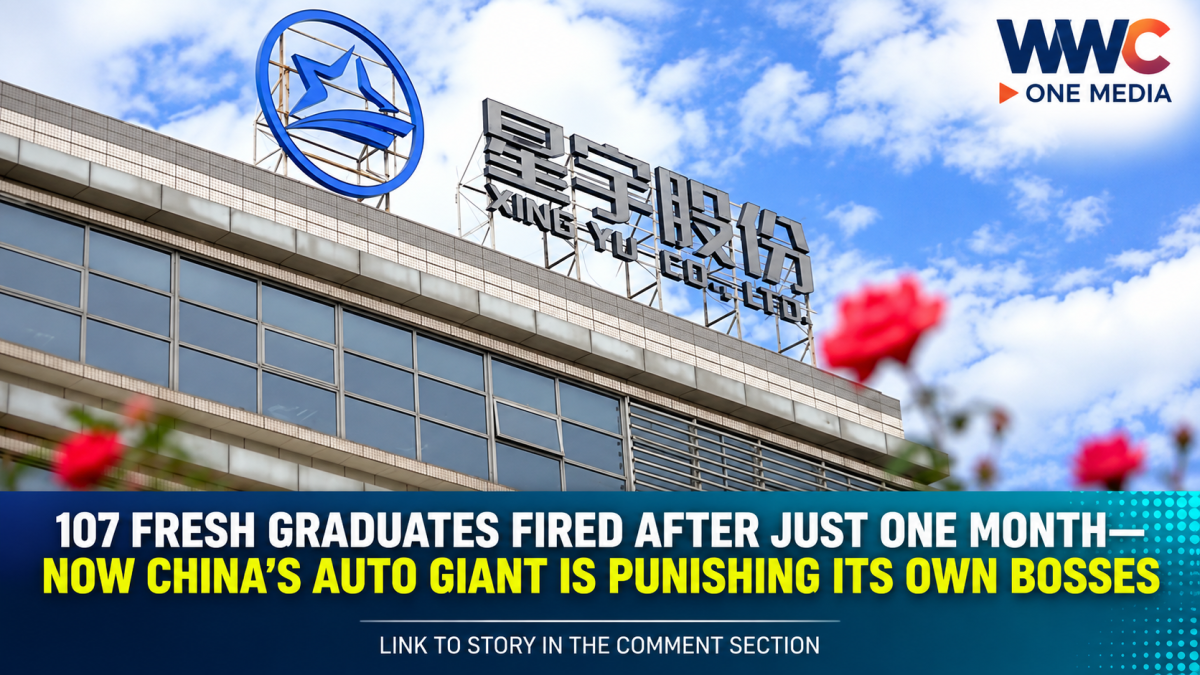
A major Chinese automotive supplier is facing intense backlash after 107 newly hired university graduates were dismissed barely more than a month after starting work, prompting an apology, financial compensation and disciplinary action against four managers.
The company at the center of the controversy is Changzhou Xingyu Automotive Lighting Systems, a Jiangsu-based manufacturer that supplies lighting components to major automakers including Volkswagen, Mercedes-Benz and BMW.
The controversy has now expanded beyond China, with global automakers scrutinizing the company’s handling of the dismissals.
From campus recruitment to termination
Xingyu recruited 440 graduates from the 2026 graduating class during its campus recruitment campaigns.
According to the Changzhou municipal human-resources authorities and Xingyu’s subsequent explanation, 372 graduates eventually joined the company. In July, management decided to reduce or reassign some of the newly hired workers after reviewing expected orders and staffing needs.
In early August, the company’s human-resources department held discussions with 140 of the new employees.
Thirty-three were allowed to retain their original positions, while 107 ultimately signed agreements terminating their employment contracts. Among those affected were 75 bachelor’s degree holders and 32 master’s degree holders. Thirty-nine worked in research and development, while others were employed in production, manufacturing and other technical or functional roles.
The timing became a major flashpoint: many of the graduates had been at the company for only a little over a month.
The controversial “two choices”
The dispute intensified after recordings and accounts circulated online.
According to reports cited by CNA and other outlets, affected graduates were allegedly presented with a choice: resign and receive roughly half a month’s salary, or accept reassignment to lower-paid frontline factory positions.
Some graduates reportedly objected to the reassignment because they had been recruited for professional positions such as research, engineering or management-related work.
One graduate quoted by The Beijing News said there had been little room for negotiation during the termination process.
The allegations triggered widespread criticism on Chinese social media and attracted the attention of local authorities.
Government investigation finds communication failures
The Changzhou Municipal Human Resources and Social Security Bureau investigated the matter and said Xingyu’s approach during consultations had been overly simplistic and blunt, with insufficient effective communication that caused an adverse social impact.
The authorities also said Xingyu had not improperly received employment or talent-related government subsidies connected to the graduate recruitment.
The controversy was significant enough that the company issued an initial apology on August 27 before announcing a more extensive corrective plan on September 7.
Executives punished
Xingyu subsequently acknowledged that management had made a mistake in assessing the company’s staffing needs and had acted too hastily.
The company announced disciplinary measures against four managers:
- General Manager Zhou Xiaoping — salary withheld for one year.
- Deputy General Manager Li Shujun — salary withheld for six months and duties adjusted.
- Human Resources Director Yu Zhiming — dismissed.
- Human Resources Department Head Li Mei — demoted and reassigned.
Xingyu also said it accepted responsibility for the controversy and apologized for the impact on the graduates and their families.
Graduates receive compensation and job assistance
The company has also introduced a compensation and employment-support package.
Each of the 107 affected graduates received a 15,000 yuan payment, roughly US$2,235, to help cover living expenses while searching for another job.
Those who remain unemployed after three months are also promised six months’ wages as compensation. Xingyu said it would reimburse transportation expenses for graduates who traveled to Changzhou for recruitment and provide free accommodation in company dormitories for those who need it.
The latest company figures cited by CNA said 71 of the 107 graduates had already found new jobs as of September 7. Local authorities have also organized job fairs and recommended vacancies to those still searching.
The controversy reaches Volkswagen, Mercedes-Benz and BMW
What began as a labor dispute at one Chinese supplier has now become a global supply-chain and corporate-governance issue.
Volkswagen confirmed on September 1 that it had opened an investigation into the dismissals. The automaker said fundamental rights and values must be respected throughout its supply chain and that it takes allegations of violations seriously.
More recent reporting has also indicated that Mercedes-Benz and BMW have received information about the case and launched their own investigations.
That scrutiny matters because Xingyu is not an obscure manufacturer. It is a major automotive-lighting supplier serving international and Chinese vehicle brands.
Why the case is bigger than 107 layoffs
The controversy comes at a difficult moment for young Chinese workers.
China’s youth labor market remains under pressure, and the Xingyu case has become a highly visible example of the uncertainty facing graduates entering the workforce. The Wall Street Journal reported that China’s youth unemployment rate reached 17.9% in July, an 11-month high.
The incident is also particularly sensitive because Xingyu is pursuing a Hong Kong listing, while global investors and automakers are placing increasing emphasis on labor practices, corporate governance and supply-chain compliance.
The case therefore raises a much bigger question: when companies face weaker demand and changing staffing requirements, how should they balance cost-cutting with commitments made to newly recruited workers?
For the 107 graduates, however, the consequences were immediate: a job they expected to begin their careers with ended only weeks after it started.
And while many have already found new employment, the controversy surrounding Xingyu is far from being only a story about layoffs—it has become a test of how Chinese companies handle young workers, labor rights and global supply-chain standards.

Leave a Reply